 RockCloud-基石云安全-官方博客
For websites, apps, APIs, payment, and AI services whose servers are deployed overseas or in Hong Kong, Macau, and Taiwan but whose core user base is in mainland China, the stability of the cross-border link directly determines user retention and transaction conversion rates. Whenever peak-hour page loading slows down, API responses time out, or audio and video stutter, the first solution that comes to mind for technical teams is often to "deploy CN2 line acceleration."
However, in actual operations, many enterprises and procurement managers discover an awkward phenomenon: they have already paid a high price to migrate their business to overseas cloud hosts advertised as "CN2 optimized," yet some domestic users still experience slideshow-like lag during peak hours. Worse, once they encounter traffic probing from competitors, the expensive premium line instantly becomes useless.
To truly achieve cross-border access for mainland China, we need to move beyond the misconception of "origin line determinism" and re-examine the modern architecture design of CN2 line acceleration from three dimensions: backbone network routing scheduling, multi-carrier traffic splitting, and edge security protection.
I. Why Buying a "CN2 Origin" Alone Often Solves Only Part of the Problem
In traditional architectural thinking, enterprises are accustomed to directly purchasing servers with optimized return bandwidth (such as CN2 cloud hosts in Hong Kong, Tokyo, or the US West) as origin servers. This approach can cope with early-stage business, but as concurrency rises or business forms become more complex, three structural bottlenecks quickly emerge:
1. "Single-Network Premium" Cannot Solve the Pain of "Cross-Network Access"
End users in mainland China are distributed across the three major carrier networks: China Telecom, China Unicom, and China Mobile. Traditional CN2 (AS4809) is essentially China Telecom's next-generation bearer network. If the origin data center only has single-line Telecom CN2 access and lacks premium return routes of equivalent quality for China Unicom and China Mobile, then traffic from Unicom and Mobile users may still degrade to the ordinary public backbone (such as the 163 backbone or ordinary international egress) when crossing borders or provinces, causing packet loss and latency spikes during peak hours.
For how to identify genuine dedicated lines and test bidirectional routing, refer to our previous technical analyses: How to Tell If It's a Real CN2 Line: Check AS4809 and 59.43, Test Both Forward and Return Paths and What's the Difference Between CN2 GIA and CN2 GT: Routing Path, Peak-Hour Performance, and Selection Criteria.
2. Premium Origin Bandwidth Is Expensive and Hard to Handle Burst Peaks
Whether it is Telecom CN2 GIA or other carriers' high-end international dedicated lines, the underlying bandwidth cost is far higher than ordinary international bandwidth. If all static resources (images, front-end scripts, audio/video segments) and dynamic requests are crammed onto the origin's direct small pipe, not only is bandwidth utilization uneven during normal times, but during major promotions or version updates, the origin port can easily be saturated instantly, causing normal requests to queue or even connection resets.
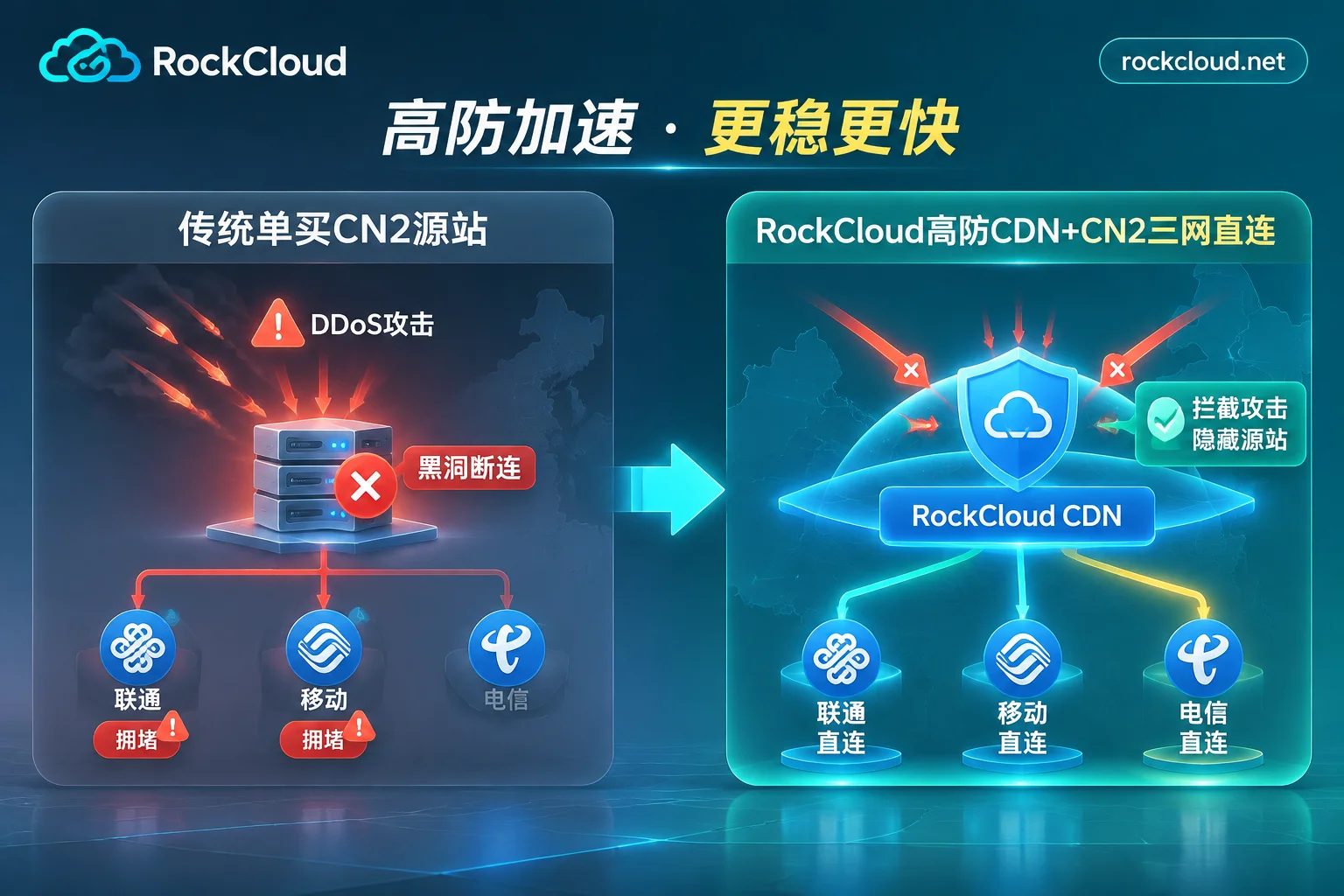
3. Lack of Pre-cleaning: DDoS Attacks Trigger "Blackhole" Immediately
This is the most fatal weakness of direct origin connection. Overseas data centers providing premium CN2 lines are usually extremely sensitive to abnormal traffic on a single IP in order to protect their expensive return dedicated lines from being overwhelmed by large traffic. As long as the origin IP is exposed on the public internet, once it encounters a DDoS or CC attack of even modest scale, the data center often immediately triggers a null route to block the IP for hours or longer. During this period, even the best acceleration line cannot save the completely interrupted business (further reading: How to Handle DDoS Attacks on Hong Kong CN2 Servers: Confirm Blackhole First, Then Change IP and Add Protection, Finally Secure the Origin).
II. The Core of Modern CN2 Line Acceleration: From "Single-Line Direct" to "Multi-Line Premium + Edge Offloading"
To break the above dilemma, more and more mature technical teams are adopting an architecture of "decoupling compute and network": no longer struggling with and frequently migrating the underlying servers. The customer's existing servers or cloud hosts continue to serve as origin (even if the origin uses ordinary international bandwidth), while a high-defense CDN acceleration network with both multi-line direct return to China and distributed security cleaning capabilities is placed in front of the origin.
In the RockCloud CN2 China Acceleration Solution, this architecture achieves a dual leap in performance and security through the following core mechanisms:
1. Telecom CN2 GIA + Unicom AS9929 + Mobile CMI Multi-Line Direct Connection
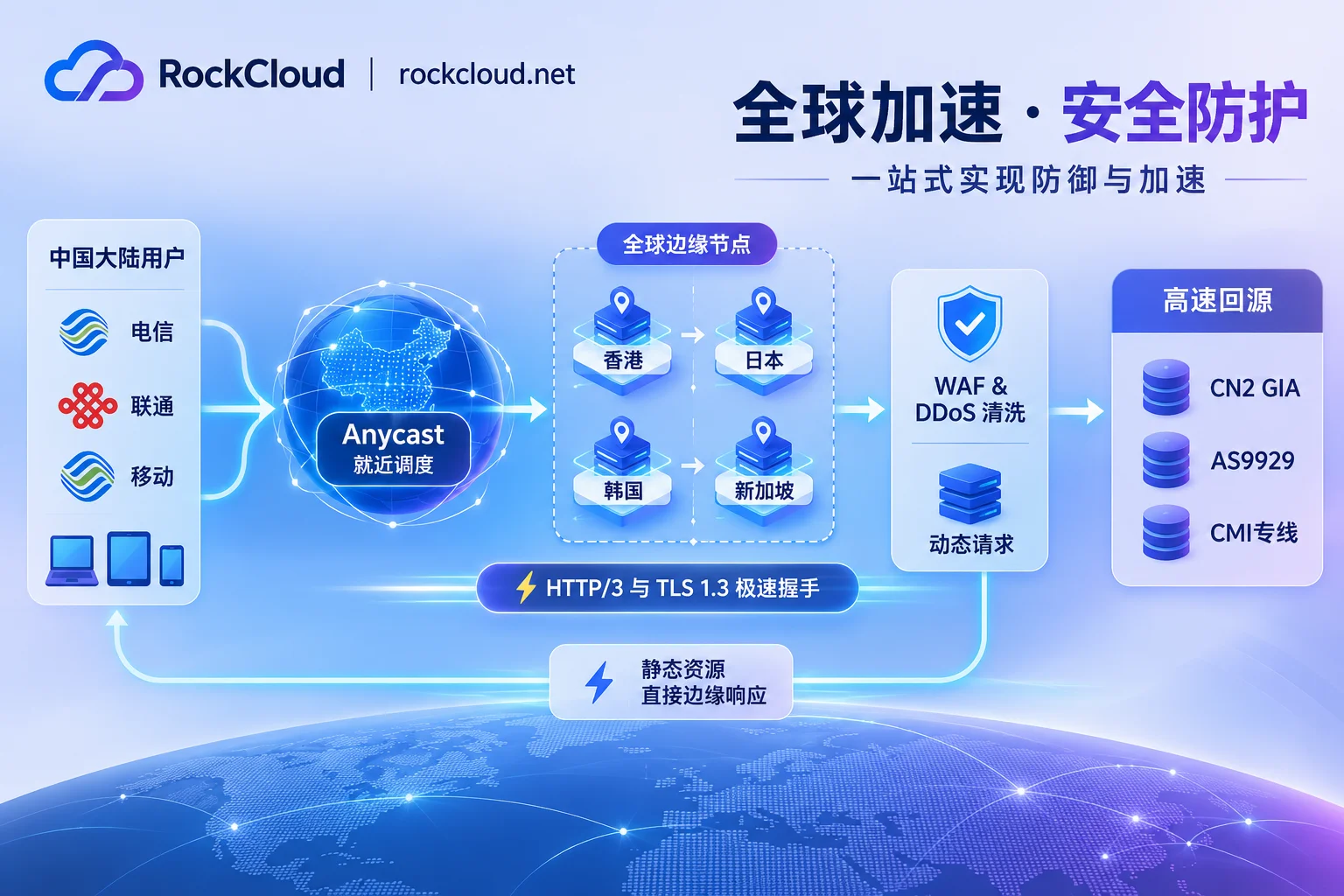
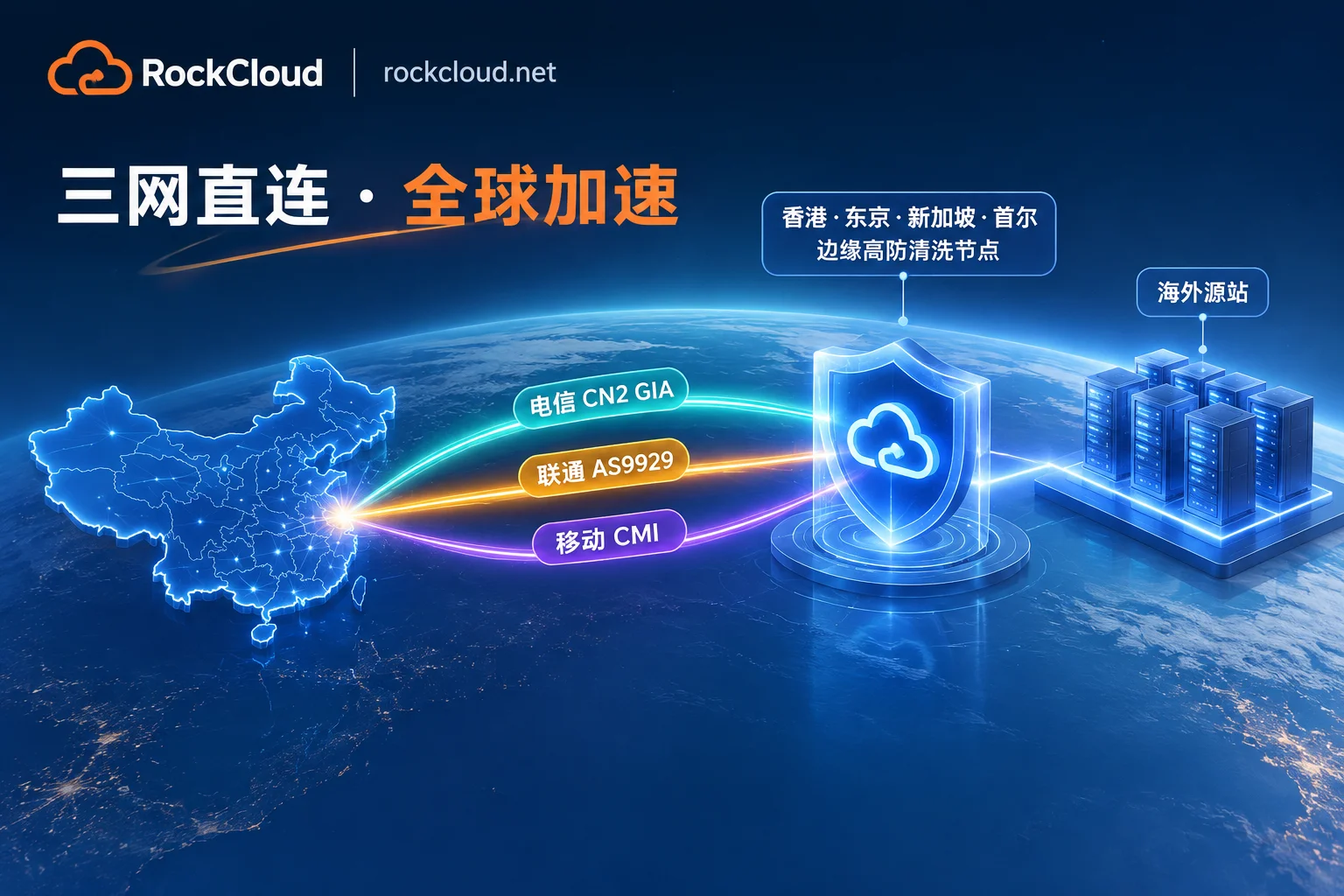
A truly all-network extreme experience requires "each taking its own highway." RockCloud's acceleration dedicated lines toward mainland China integrate the top return routes of the three major carriers at core nodes around China (including Hong Kong, Japan, South Korea, Singapore, etc.):
- China Telecom direction: Uses CN2 GIA (Global Internet Access) premium route throughout, with independent QoS priority guarantees, avoiding the congested 163 backbone and maintaining extremely low packet loss and jitter even during peak hours.
- China Unicom direction: Connects to AS9929 (Unicom A-network/premium network). Compared with the ordinary AS4837 civil network, it has lighter load and fewer cross-border hops, greatly improving access response for users in northern China and on Unicom broadband.
- China Mobile direction: Directly connects to the Mobile CMI international premium line, solving common detours and speed limits for Mobile broadband and cellular users in cross-border access.
Through Anycast proximity access and latency-based automatic routing technology, the system automatically matches the optimal return channel based on the visitor's carrier attributes and real-time network conditions.
2. Protocol Stack Optimization and Private Backbone Transmission
In addition to physical line upgrades, the efficiency of transport and application layer protocols is equally critical. Under the Global CDN Acceleration Architecture, edge nodes fully support HTTP/3 (QUIC) and TLS 1.3 0-RTT handshake protocols, combined with Brotli compression. This means that even in weak mobile network environments, connection round-trip time (RTT) and transmission volume can be significantly reduced.
At the same time, operations personnel can customize fine-grained caching rules, origin retry, and backup origin policies. A large amount of static and semi-dynamic content is responded to directly at near-shore edge nodes such as Hong Kong, Japan, South Korea, or Singapore; dynamic requests that need to return to origin are forwarded at high speed through the private backbone via CN2 dedicated lines, greatly reducing origin bandwidth expenditure and computational load.
3. ICP-Free and CNAME Seamless Integration
Overseas entities or reverse-going projects expanding into mainland China often get stuck in the lengthy ICP filing process for domestic CDNs (for discussion, see: Why ICP-Free CDN Domestic Access Is Often Slow: Return Route, High-Defense Cleaning, and NS-Free Integration).
By connecting to CN2 acceleration nodes around China, businesses can legally and compliantly obtain low-latency experiences comparable to domestic nodes without going through cumbersome ICP filing. In terms of integration, there is no need to modify the domain's NS records; DNS remains with the original provider, and only a CNAME record needs to be added. During the switch, old and new links run in parallel, achieving zero-downtime smooth transition.
III. Integrating Acceleration and Security into One Link: Cross-Border Dedicated Lines That Are Not Afraid of Attacks
Many enterprises easily make another mistake when selecting solutions: separating "buying acceleration" and "buying high defense." If a high-defense node with only defense but no optimized line is placed in front, domestic access will still be slow; if only an ordinary CN2 CDN is used, it will still be paralyzed when attacked.
In RockCloud's product system, acceleration and defense run on the same request path and are included in the same base package framework:
- Origin Hiding and Anycast Distributed Cleaning: After integration, the origin's real IP is completely hidden. When encountering large-traffic DDoS attacks, the Anycast network completes distributed cleaning directly at the global edge and will not transmit malicious floods to the return dedicated line or customer origin (if emergency integration is needed during an ongoing attack, simply change the origin IP and configure the firewall to only allow return nodes to fully secure it).
- Integrated DDoS and CC Defense: No need to separately purchase Layer 3/4 traffic cleaning and Layer 7 application protection. The control panel supports one-click activation of the Intelligent WEB Firewall (WAF), intercepting SQL injection, XSS, malicious scripts, and scanners based on the OWASP core rule set, and combining machine learning models to identify in real time variant CC requests and automated bot API abuse not yet included in the rule base.
- Customized Security Collaboration: For complex API authentication or special business paths, the security technical team can assist in configuring custom rules and exception allow policies, and cooperate with security tokens, signed URLs, IP/region blacklists and whitelists, and anti-hotlinking and other general security features, blocking attacks without accidentally harming normal domestic users.
IV. CN2 Acceleration Implementation Guide for Different Business Scenarios
Different business forms have differentiated requirements for network protocols and additional capabilities, and can be combined as needed with industry solutions:
- Websites, Apps, and High-Concurrency APIs (Payment/AI Services/Web3): Directly use High-Defense CDN plus CN2 China Acceleration Dedicated Line. Leverage fully automatic free SSL, TLS 1.3 0-RTT, and multi-line direct connection to reduce API time to first byte (TTFB). If the business domain encounters regional carrier blocking, DNS pollution, or WeChat/QQ blocking in China, you can also directly add the Blocking and Pollution Recovery Service, achieving in-place recovery without changing the domain through pollution cleaning and imperceptible 301 redirects.
- TCP/UDP Full-Protocol Real-Time Interactive Games: For non-HTTP heavy mobile or PC games, the Game Shield Architecture is recommended. Game traffic is encapsulated in a private protocol and forwarded through distributed edge nodes and premium return routes; even if a front-end node encounters a high-intensity attack, the system can switch to a high-defense node within seconds while keeping player connections uninterrupted.
- Cross-Border HD Live Streaming and VOD Platforms: Can be combined with the Video CDN Solution, supporting mainstream streaming protocols such as RTMP/RTSP/HLS/MPEG-DASH/MPEG-TS and playback of MP4/HLS/CMAF, providing security tokens and Multi-DRM content protection, solving stuttering and piracy issues in cross-border audio/video transmission.
- Cloud Infrastructure Procurement and Compliant Settlement: If your origin is hosted on AWS, Azure, GCP, Alibaba Cloud International, Tencent Cloud International, Huawei Cloud International, etc., RockCloud also provides International Cloud Free Account Opening and Top-Up Service without enterprise verification and real-name procedures, supporting convenient USDT settlement, forming a complete closed loop with front-end high-defense CDN and CN2 acceleration.
V. Controllable Cost Billing Model: Say Goodbye to "Sky-High Bills" from Pay-As-You-Go
In traditional cloud vendor billing systems, CN2 premium traffic and pay-as-you-go CDNs are often disaster areas for budget overruns—once malicious theft or a sudden CC attack occurs, a traffic bill charged per GB may drain project profits overnight (see: What to Do When CDN Is Maliciously Stolen and DDoS Attacks Cause Sky-High Bills).
RockCloud adopts a transparent and predictable package billing mechanism:
- Fixed monthly peak billing, unlimited traffic and requests: Completely eliminates the fear of sky-high traffic bills caused by burst access or malicious brushing.
- Defense at no extra charge: The base package already fully includes DDoS/CC defense, WAF, and free SSL, with CN2 mainland acceleration dedicated lines and anti-hijacking features transparently added as needed.
- Flexible business support: Supports customized contract quotations, accepts USDT or USD payments; provides a modern control panel with real-time traffic reports, network logs, multi-domain batch operations, and Telegram real-time data push.
If you are evaluating the acceleration and protection performance of different vendors, you can refer to our Selection Comparison Center to learn about architectural differences from Alibaba Cloud, Cloudflare, AWS, and traditional high-defense servers. You can also contact our engineers at any time via the Contact Page or official Telegram (@rockclouds) to discuss business specifications, apply for free testing, and personally verify the smooth peak-hour experience brought by multi-line direct CN2 acceleration.



Comments(0)