 RockCloud-基石云安全-官方博客
With the explosion of microservices architectures, mobile apps, and AI applications, APIs have evolved from backend data channels to the core entry points of enterprise services. However, traditional network-layer (L3/L4) defenses often fall short when confronted with application-layer (L7) DDoS attacks targeting APIs. Building an efficient API DDoS protection system hinges on establishing a layered defense mechanism of "edge scrubbing + business logic validation + dynamic rate control," which not only prevents malicious traffic from overwhelming backend databases and microservices but also ensures low-latency experiences for legitimate users.
Industry Trends: AI-Enhanced L7 API DDoS Attacks on an Industrial Scale
Recent research from leading security agencies reveals a dramatic evolution of the API threat landscape:
- API attacks have doubled in frequency: According to Akamai's "Apps, APIs, and DDoS 2026" security report, 87% of surveyed enterprises experienced API security incidents in the past year; the average daily API attack volume increased by 113% year-over-year, and L7 application-layer DDoS attacks surged by 104% over two years.
- Attacks shift to unauthorized workflows: Approximately 61% of observed API attacks involve unauthorized workflows and anomalous behavior. Attackers are no longer relying solely on brute-force traffic floods; instead, they mimic legitimate client calls to complex endpoints (such as search, authentication, and payment requests), causing resource exhaustion on origin servers.
- Industrialization and automation proliferation: Cloudflare's 2026 threat report notes that AI-assisted tools and Botnet-as-a-Service make it extremely cheap and fast to launch high-RPS (requests per second) precision API DDoS attacks.
For SRE and security operations teams, API attacks mean not only bandwidth consumption but also backend database connection pool exhaustion, inflated third-party API bills, and even infrastructure downtime.
Core Characteristics of API DDoS Attacks and Common Protection Misconceptions
Compared to traditional DDoS attacks targeting HTML web pages, attacks on API endpoints exhibit the following distinctive features:
- Precision targeting of high-consumption endpoints: Attackers often select endpoints that consume significant CPU and database I/O (e.g., data exports, complex searches, token generation), using a small number of requests to deplete origin server resources.
- Short-burst patterns: Many attacks occur in brief, intense bursts lasting 2-3 minutes, aiming to destabilize business operations before manual responses or dynamic mitigation can take effect.
- Bypassing static IP rate limits: By leveraging distributed botnets, attack source IPs are highly dispersed, with each IP making requests that stay within static thresholds, rendering per-IP rate limiting ineffective.
Common misconception: Deploying rate limiting only at the origin server. When hundreds of thousands of malicious requests penetrate directly to the origin gateway, intercepting at the application layer still consumes significant CPU and TCP connection resources, failing to fundamentally resolve service unavailability.
Modern API DDoS Protection Architecture Selection Guide
To comprehensively resist hybrid API attacks, enterprises need to build a layered defense solution with elastic scaling and intelligent identification capabilities:
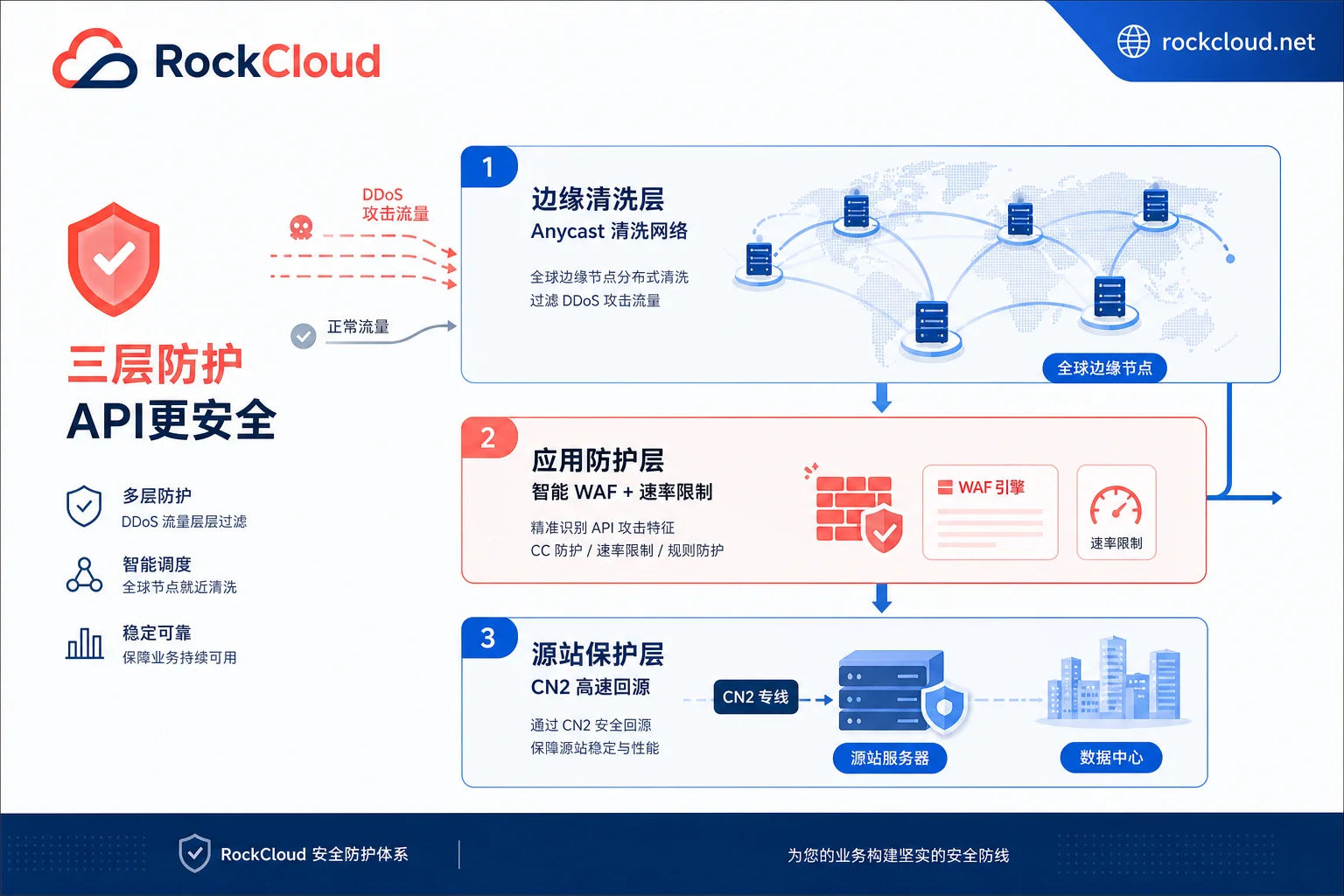
1. Edge Anycast Network and Traffic Scrubbing
Hide API entry points behind an edge network with global Anycast scrubbing capabilities. Edge nodes can automatically absorb and mitigate L3/L4 TCP SYN floods and UDP amplification attacks, ensuring attack traffic never directly reaches the origin server's real IP addresses.
2. Dynamic Client Behavior Identification and Intelligent WAF
Use an intelligent WAF to validate API schemas (such as Open API/Swagger) and reject illegitimate parameter requests. Additionally, combine client fingerprinting (TLS fingerprint, HTTP header characteristics) with machine learning-based behavioral analysis to accurately distinguish automated scripts from real users.
3. Multi-Dimensional Fine-Grained Rate Limiting
Abandon single IP-based rate limiting in favor of multi-dimensional rate control that incorporates tokens, user IDs, API keys, and paths. Implement strict sliding window limits for high-sensitivity APIs such as login, verification code sending, and resource queries.
4. Link Acceleration and Origin Server Hiding
While performing security scrubbing, it is crucial to ensure an optimal API response experience. For cross-border and complex domestic network environments, leveraging premium dedicated lines for acceleration is vital.
RockCloud API Security and Scrubbing Architecture Practice
To address the API protection and access acceleration needs of complex enterprise businesses, RockCloud provides a comprehensive security system that integrates high-defense CDN, intelligent WAF, Anycast global network, and CN2 China dedicated lines. In API security scenarios, RockCloud's solutions offer multiple layers of protection for enterprise architectures:
- Edge Traffic Filtering and High-Defense CDN: Leverage a distributed Anycast high-defense network to intercept massive L3-L7 abnormal traffic at edge nodes closest to the attack source, preventing exposure of origin IPs.
- Customized WAF Rules and Complex Business Adaptation: Given the frequent data interactions and complex logic of APIs, RockCloud's intelligent WAF supports flexible custom rule configuration and contextual analysis, enabling precise blocking of L7 API DDoS abuse that exploits unauthorized workflows.
- Low-Latency Dedicated Line Transmission: While defending against attacks, the integration of CN2 premium China dedicated lines and Anycast acceleration provides a stable, low-latency network channel for API responses, achieving both security and performance.
Reader Interaction: Assess Your API Defense Readiness
When attackers use tens of thousands of distributed IPs to hit your login or data query APIs at tens of thousands of RPS, does your current system have the capability to defend?
- [ ] Are your source code and API endpoints hidden behind an edge proxy, concealing the origin's real IP?
- [ ] Is intelligent WAF validation based on rules and behavioral characteristics enabled for core APIs?
- [ ] Do you have the ability to enable advanced scrubbing and global rate limiting within minutes?
If you encounter challenges in API protection deployment, scrubbing rule configuration, or cross-border API latency optimization, feel free to contact the RockCloud technical team to obtain a customized high-defense CDN and API security defense architecture evaluation proposal.


Comments(0)