 RockCloud-基石云安全-官方博客
Opening: Behind the 31.4 Tbps Peak, the Real Change Is in Attack Source Structure
According to public threat reports from Cloudflare and NETSCOUT in 2026, global DDoS attack peaks have reached 30–31.4 Tbps, launched by botnets like Aisuru-Kimwolf composed of 1 to 4 million IoT/Android TV devices. Facing such attack volumes, enterprise botnet DDoS protection is shifting from "blocking a specific IP" to "completing edge capacity and automated mitigation within tens of seconds."
What matters isn't the peak number, but three characteristics: extremely distributed source IPs, low per-device rates, and extremely short attack windows. Most record-level attacks last under 5 minutes, some merely 35 seconds. Can your scrubbing pipeline complete capacity and detection within tens of seconds? That's the core question this article addresses.
Why IP Blocking, Geo-Blocking, and Manual Response Fail Against Botnet Attacks
Let's first examine a common assumption: if you can identify and block attack source IPs, the attack traffic will be kept out. But against botnets of Aisuru-Kimwolf's scale, this assumption fails in at least three ways.
- Source IP count far exceeds rule capacity. With 1 to 4 million devices, millions of distributed source IPs can appear simultaneously; blacklist/whitelist maintenance and matching efficiency simply can't keep up.
- Low per-device rates make it indistinguishable from normal traffic. Each IoT device may generate low-rate traffic, and the overall attack is fragmented into countless "seemingly normal" requests, making rate-threshold detection ineffective.
- Attack windows are extremely short, leaving no time for manual response. Record-level attacks can last under 5 minutes, even 35 seconds, and the process from detection to alert to human intervention often isn't completed before the attack ends.
A deeper architectural issue lies in centralized scrubbing. According to 2026 public industry analysis, traditional solutions redirect traffic to centralized scrubbing centers (tromboning), but redirecting itself introduces latency, and physical uplinks may saturate before scrubbing takes effect. So, how to intercept attacks from distributed source IPs? The answer isn't longer lists or faster human response, but where traffic lands.
| Traditional Assumption | Current Attack Characteristics | Failure Point |
|---|---|---|
| Source IP count is limited, manageable via blacklists/whitelists | 1–4 million devices form botnets, source IPs extremely distributed | Rule tables can't handle massive IPs, and they change rapidly |
| Suspicious traffic rates are significantly higher than normal | Low per-device rates, overall traffic fragmented into massive low-rate requests | Rate-threshold detection struggles to pick out low-rate attacks |
| Attacks last long, leaving manual response windows | Record-level attacks last <5 minutes, even 35 seconds | Minute-level manual processes can't match second-level attacks |
| Centralized scrubbing center can handle redirection | Redirection adds latency, physical uplinks saturate first | Scrubbing isn't active, access links already exhausted |
Four Dimensions to Assess Your Botnet DDoS Protection Capability
To know if your defenses are adequate, first conduct a hyper-volumetric DDoS scrubbing capability assessment, then discuss vendor selection. Use the 30–31.4 Tbps peak from 2026 public threat reports as a reference ceiling, but at least four dimensions must address internal doubts.
1. Scrubbing Capacity and Bandwidth Redundancy. Using the record-level peak from the previous section as an upper reference, check the burst redundancy of your uplink and scrubbing devices before traffic redirection takes effect. Question: If an attack of similar magnitude suddenly hit, how many seconds until your access link saturates? If this isn't up to par, the access link will be the first to fail: before redirection kicks in, the physical uplink may be flooded; with attack windows as short as 35 seconds, once the link is saturated, legitimate traffic will be dragged down too.
2. Capacity to Handle Massive Distributed Source IPs. Rule count isn't key; whether edge nodes can track sessions from millions of source IPs simultaneously is. Question: When 1 million devices connect at once, are your session table entries and CPU still under control?
3. Protocol and Vector Coverage. Beyond network-layer volumetric attacks, do you cover hybrid scenarios that penetrate to the application layer? Question: Do network and application layers have independent detection and judgment capabilities, and can strategies coordinate during multi-vector attacks?
4. Policy Deployment and Effective Latency. Attack windows are measured in seconds; policy deployment from detection to network-wide effect must be automated and fast. Question: What's your measured policy deployment latency? How does it compare to the second-to-minute windows typical of record-level attacks? If deployment latency is too long, manual processes may not even start before the attack ends in tens of seconds, rendering the entire scrubbing pipeline useless; record-level attacks can last as little as 35 seconds, and minute-level latency makes protection meaningless.
These four dimensions—capacity, sessions, vectors, and latency—are baseline indicators for whether your existing scrubbing capability keeps up with 2026 attack characteristics.
Layered Defense Architecture: Edge Anycast Offload → Fingerprint & Behavior Detection → Application-Layer Fallback → Origin Hiding
Against short bursts with massive distributed source IPs, a sustainable IoT botnet DDoS protection solution isn't about a single device but a layered architecture centered on Anycast edge scrubbing.
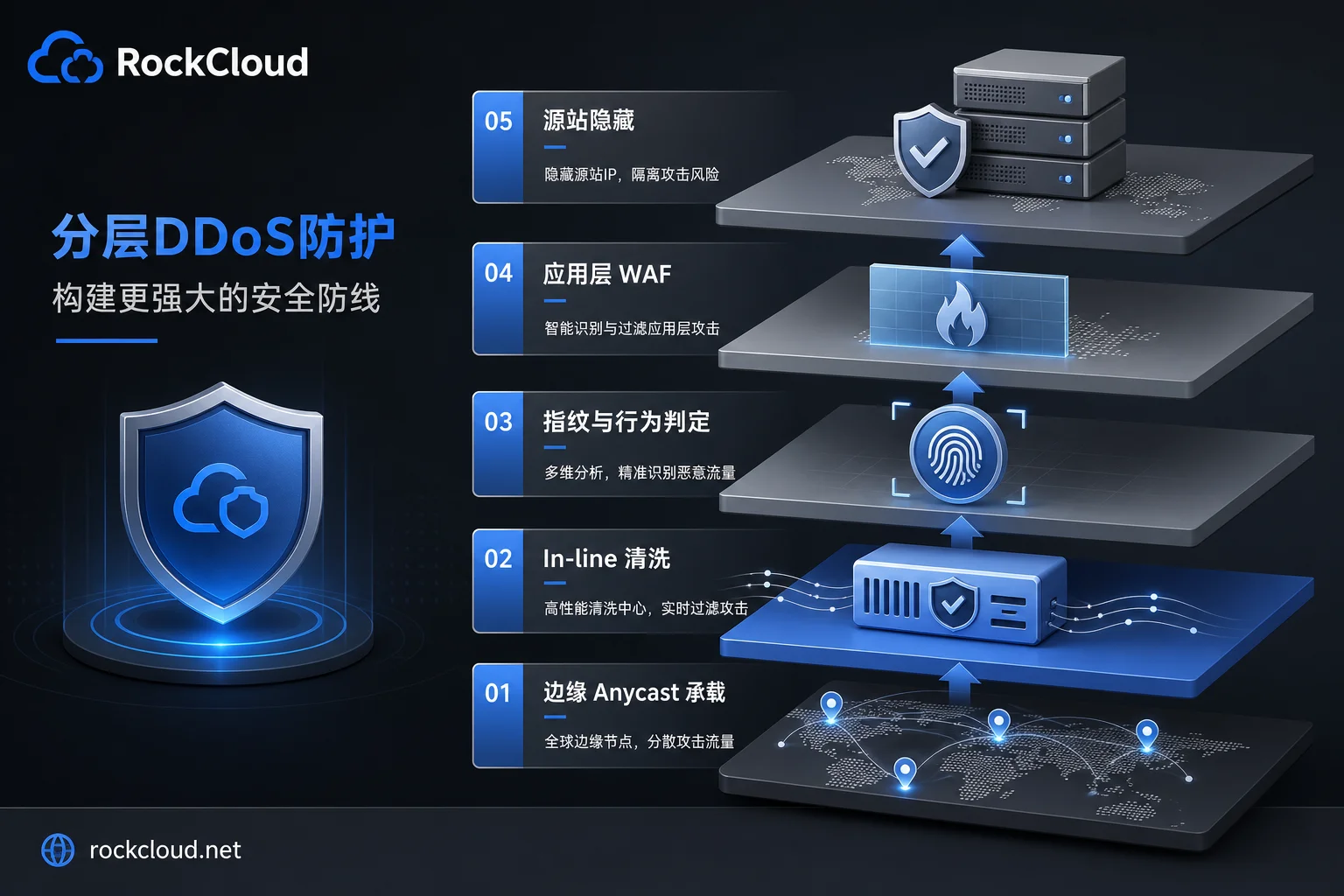
Layer 1: Edge Anycast Offload. Distribute traffic across multiple edge nodes rather than funneling to a single point, physically avoiding single-link overload.
Layer 2: In-line Real-Time Scrubbing at the Edge. Perform online detection and scrubbing directly at edge nodes before traffic reaches your origin, avoiding redirection latency and link saturation issues.
Layer 3: Fingerprint and Behavior Detection. Don't rely on source IP lists; use device fingerprints and behavioral characteristics as judgment criteria, adapting to the highly distributed, low-rate attack structure.
Layer 4: Application-Layer Fallback and Origin Hiding. After edge scrubbing, filter residual traffic at the application layer; simultaneously hide origin IPs to reduce the attack surface, preventing attackers from directly hitting the origin.
The core shift in this architecture is from "identifying and blocking source IPs" to "offloading at the edge and automatically mitigating," a mainstream evolution direction for countering hyper-volumetric botnet attacks.
How RockCloud Fits into This Layered Architecture
Breaking down the four layers, RockCloud's public capabilities align as follows.
- Anycast Global Network and Edge Scrubbing: Covers Layer 1 edge distributed offload and In-line real-time scrubbing, handling near-source distribution of ultra-large traffic.
- High-Protection CDN and Origin Hiding: Reduces business exposure, preventing origin IPs from being directly resolved, decreasing attack likelihood at the source.
- Intelligent WAF and Game Shield: Provide application-layer fallback detection before residual traffic reaches the origin, handling traffic that penetrates to the application layer.
- CN2 Dedicated Line: Ensures stable return of scrubbed legitimate traffic, preventing the return path from becoming a new bottleneck.
With clear responsibilities across layers, teams can fill gaps layer by layer based on business exposure, rather than relying on a single solution for all scenarios.
Botnet DDoS Protection Self-Checklist for Enterprises
Finally, condense the four dimensions and four layers into a checklist for team review. The more items you can affirm, the stronger your resistance.
- [ ] Have you assessed uplink performance under pressure before traffic redirection, using the record-level peak (30–31.4 Tbps) as an upper reference?
- [ ] Do critical protection strategies rely on source IP blacklists/whitelists? Can they be replaced with fingerprint or behavior detection?
- [ ] What's the measured latency from detection to network-wide policy effectiveness? Is it measured in seconds?
- [ ] Can origin IPs still be directly resolved? Are they all hidden?
- [ ] Are edge nodes in-line scrubbing or centralized redirection?
- [ ] Is application-layer protection independent of network-layer, with judgment capability not requiring source IP lists?
- [ ] Can policies automatically take effect before the attack window ends (compare measured latency with second-level attack windows)?
- [ ] Does session handling capacity meet millions of concurrent source IPs?
- [ ] Is there an automated response mechanism to reduce minute-level manual latency?
- [ ] Is there quality assurance on the return path after scrubbing to avoid secondary congestion?
Botnet DDoS protection weaknesses typically concentrate in three areas: capacity, detection, and policy deployment latency. We recommend auditing your existing pipeline accordingly. To assess edge capacity and layered scrubbing implementation, contact the RockCloud technical team to discuss tailored to your architecture.
References:



Comments(0)