 RockCloud-基石云安全-官方博客
High-Defense CDN Does Not Require NS Changes
Accessing a high-defense CDN does not necessarily require modifying your domain's NS (Nameserver) records. Except for a few platforms that default to full-site DNS hosting, the vast majority of protection and CDN providers offer CNAME resolution access, allowing you to keep your existing authoritative DNS provider while only directing traffic from specific domains needing protection to high-defense nodes.
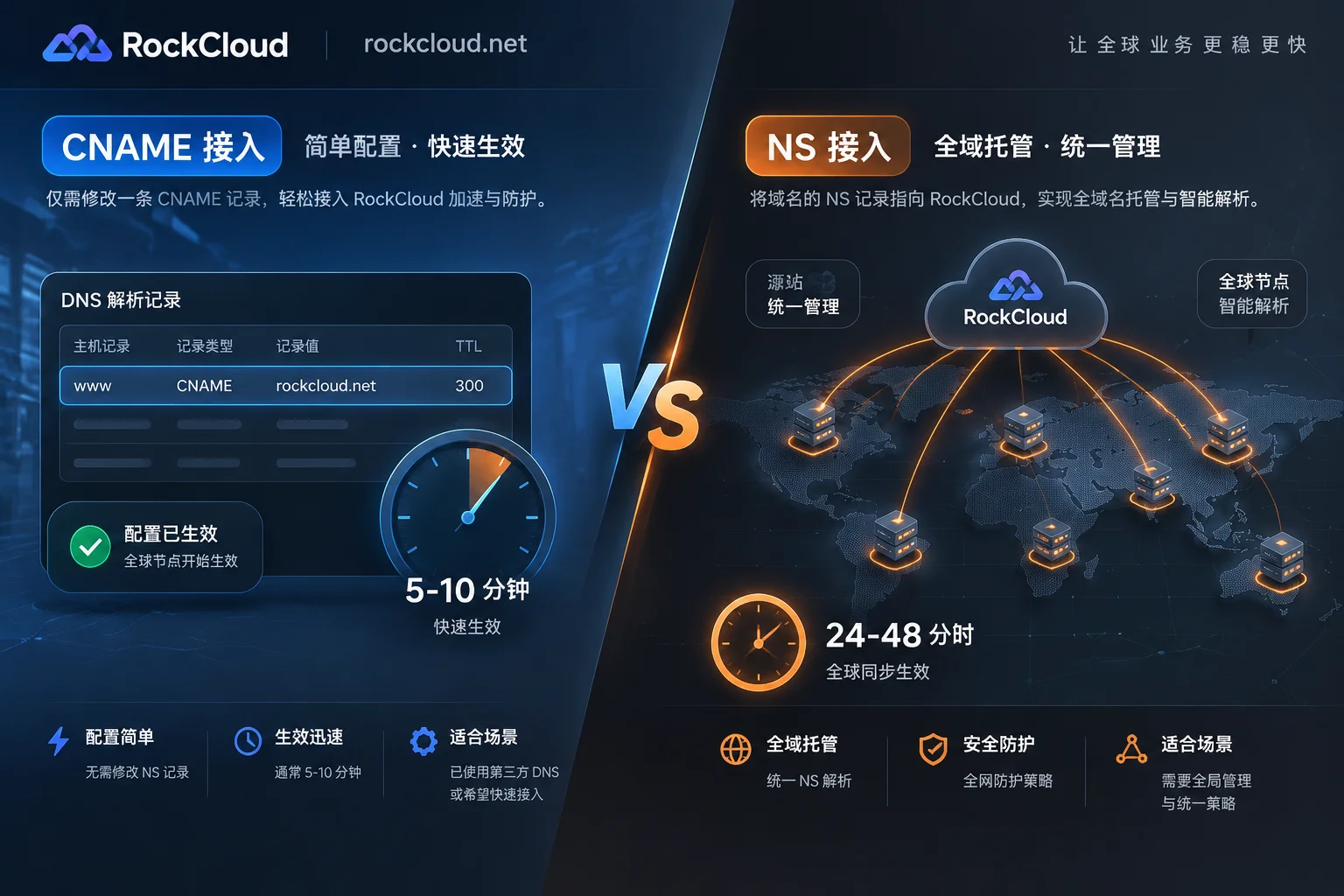
The core differences between the two access methods lie in whether authoritative DNS hosting control is transferred, activation speed, and the scope of protection.
Advantages and Limitations of CNAME Access
Advantages
- No change to authoritative DNS hosting control: You only need to modify the alias resolution for the corresponding subdomain (e.g., change the A record of
www.example.comto a CNAME pointing to the high-defense node domain). This does not affect other records under the domain such as enterprise email (MX), TXT, SPF, etc. - Fast activation: Depends on the TTL (Time To Live) of the current DNS records. If TTL is shortened in advance to 300 seconds (5 minutes), CNAME switching typically takes effect globally within minutes to 10 minutes.
- Low cost for emergency rollback: In case of failure or need for escape, simply change the CNAME back to the origin A record or the original CDN, and recovery can be achieved in as little as a few minutes.
Limitations
- Root domain access constrained by RFC specifications: Under RFC standards, the root domain (
@or Zone Apex, such asexample.com) conflicts with certain record types (MX, SOA) and cannot directly configure a CNAME. You need your original DNS provider to support CNAME Flattening, ALIAS, or ANAME records to achieve root domain alias resolution. - Only protects application-layer and layer-4 forwarding traffic: In CNAME access mode, the high-defense CDN can only protect HTTP/HTTPS traffic accessed through that domain and layer-4 port forwarding traffic. If the original DNS server itself suffers attacks targeting the resolution layer such as DNS Query Flood or NXDOMAIN floods, this mode cannot directly provide protection.
Advantages and Limitations of NS Access
Advantages
- Root domain can directly configure protection proxy: After delegating all authoritative resolution of the domain to the security provider, the root domain (
example.com) can directly configure protection nodes without relying on ALIAS-type extension record support. - Also enjoy high-defense DNS service: Capable of resisting DDoS attacks targeting the resolution layer (DNS Query Flood, NXDOMAIN floods, etc.), protecting authoritative DNS servers from being taken down.
- Unified full-domain hosting for easy management: Suitable for scenarios with many subdomains requiring unified management of all DNS records.
Limitations
- High migration cost: Before access, all existing DNS resolution records (A, MX, TXT, SRV, etc.) need to be migrated to the high-defense provider's DNS hosting platform. During migration, record completeness must be carefully verified.
- Long global activation time: NS record changes are affected by top-level domain registry caches. Full global synchronization typically takes several hours to 24-48 hours. If the business is under attack, it will remain down during this delay, failing to meet emergency mitigation needs.
- Complex rollback operation: If you need to switch back to the original DNS provider, you must modify NS records again and wait for global propagation, and the original DNS resolution records need to be resynchronized back to the original platform.
Selection Criteria: First Assess Situation, Then Architecture
Emergency Mitigation Scenario: Firmly Use CNAME Access
If your business is currently under attack, the primary goal is minute-level mitigation and restoration of access. In this case:
- Shorten the TTL of original DNS records to 300 seconds or less (some DNS providers support a minimum of 60 seconds).
- Point the CNAME of the domain needing protection to the access domain provided by the high-defense CDN (e.g.,
xxx.rockcloud.net). - If the origin server's public IP was previously exposed, simultaneously change the origin IP or configure the origin firewall to only allow high-defense back-to-origin IP ranges, preventing attackers from bypassing the CDN and directly attacking the origin.
Do not modify NS records during an emergency. The global propagation window for NS will cause business downtime for hours to two days.
Regular Access or Procurement Selection Scenario
If your business is not under attack and you are doing routine protection hardening or procurement selection, choose based on the following conditions:
When to Prefer CNAME Access
- Existing DNS resolution architecture is complex, containing many MX, TXT, SRV records, making migration costly.
- Need to retain flexible control over DNS hosting, avoiding full delegation to a single provider.
- Only need to protect some subdomains (e.g.,
www,api,cdn, etc.), while other domains or records do not need to go through high-defense nodes.
When to Consider NS Access
- The root domain (
example.com) needs direct protection proxy configuration, and the original DNS provider does not support ALIAS/ANAME records. - The authoritative DNS server itself frequently suffers DNS-layer attacks (Query Flood, reflection amplification, etc.) and needs high-defense DNS service support.
- Wish to uniformly host all subdomains on the high-defense provider's DNS platform for simplified management.
RockCloud's Access Support
RockCloud supports both CNAME and NS access methods. For emergency mitigation or complex DNS architecture businesses, CNAME access allows quick access to protection. Specific configuration methods and back-to-origin IP range whitelists can be obtained through the console during the free trial. For NS full hosting access or root domain protection, contact technical support before access to confirm the migration checklist and cutover plan.
Summary of Key Checkpoints
| Access Method | Activation Speed | Protection Boundary | Applicable Scenarios |
|---|---|---|---|
| CNAME Access | Minutes to 10 minutes (depends on TTL) | HTTP/HTTPS application layer and layer-4 forwarding traffic | Emergency mitigation, complex DNS architecture, partial domain protection |
| NS Access | Several hours to 24-48 hours | Full domain traffic + authoritative DNS layer protection | Root domain protection, unified full-domain hosting, DNS layer attack protection |
Regardless of the access method, after the origin IP is exposed, you must simultaneously change the origin IP or configure a back-to-origin IP range whitelist to prevent attackers from bypassing the CDN and directly attacking the origin.


Comments(0)