 RockCloud-基石云安全-官方博客
For mobile app backends, payment callback gateways, AI model inference services, and Web3 node interfaces, APIs have become the core arteries of the entire business system. Unlike traditional web browsing, API interactions are highly real-time, involve high-frequency dynamic reads and writes, and have strict client format specifications. Once an API domain suffers a DDoS attack, even a few seconds of handshake timeout or tens of milliseconds of extra jitter can directly cause widespread client errors, dropped payment orders, or cascading failures in downstream call chains.
According to recent global security reports, the number of DDoS attacks targeting API endpoints has grown significantly faster than those against traditional websites, and attack patterns are rapidly evolving toward "multi-vector hybrids." Building on our previous discussion in "How to Defend APIs and Dynamic Interfaces Against CC Attacks: Handling Low-Frequency Slow Attacks, Residential Proxies, and High-Concurrency API Abuse," this article moves beyond a single Layer 7 rate-limiting perspective and focuses on four dimensions: Layer 4/7 hybrid flood defense, mechanisms to avoid blocking legitimate clients, low-latency API communication assurance, and full-chain origin server closure. We will analyze an API DDoS protection architecture suitable for production environments.
I. Why Are APIs More Vulnerable to DDoS Threats Than Regular Websites?
In actual attack and defense emergencies, many operations teams find that protection strategies that work well for official websites often fail when directly applied to api.example.com, resulting in either "unable to defend" or "defense causes collapse." This mainly stems from three core pain points of current API DDoS attacks:
- L3/L4 Traffic Floods and L7 Request Bursts Occur Simultaneously
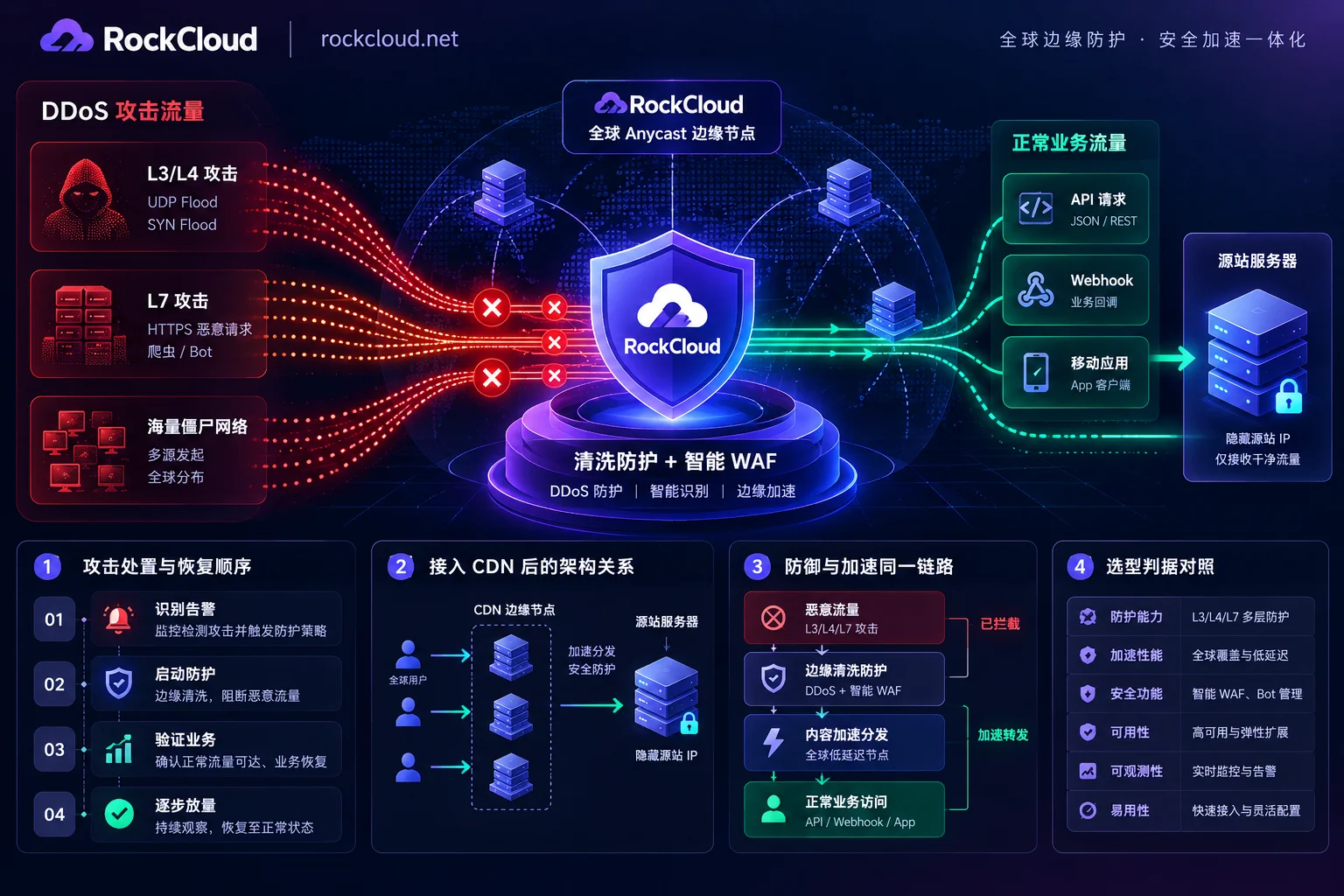
Modern botnets rarely launch single-dimension attacks. Attackers typically first use large-volume UDP Floods or SYN Floods to overwhelm network bandwidth and gateway connection tables, then immediately mix in a large number of HTTPS requests with random headers and TLS fingerprints to hit API endpoints directly. If an enterprise's Layer 4 DDoS scrubbing and Layer 7 application protection are purchased separately and deployed serially across different service providers, not only is cross-network forwarding latency high, but policy coordination also often has gaps. - Inability to Use Traditional Human Verification Leads to "Defensive Suicide"
When a website is under attack, high-defense nodes can pop up slider CAPTCHAs, five-second shields, or JS challenges to filter bot traffic. However, API callers are mobile app code, third-party servers (such as WeChat/Alipay/Stripe Webhook callbacks), or IoT devices. These clients cannot parse JS challenges. Once the protection platform mistakenly triggers browser verification, all legitimate clients will instantly disconnect. - Backend Compute and Connection Pools Are Extremely Fragile
API requests almost never hit static caches. Every malicious packet that slips past the edge defense directly penetrates to the origin gateway, consuming TLS handshake compute, database connection pools, and even expensive GPU inference resources (such as long-context exhaustion attacks on AI interfaces).
II. Core Architecture of API DDoS Protection: Same-Path Scrubbing and Precise Identification
To resolve the above contradictions, API DDoS protection cannot rely on origin servers to tough it out, nor should it use pieced-together security components. Instead, an integrated defense line of "perception, scrubbing, verification, and forwarding" must be built at the edge network.
1. Anycast Distributed Traction, Layer 4/7 Same-Path Scrubbing
After integrating RockCloud High-Defense CDN and DDoS/CC Protection, the API domain's resolution will point to a distributed edge network, completely hiding the customer's real origin server or cloud host IP. When large-traffic attacks strike, the Anycast network will pull and distribute anomalous floods from around the world to nearby locations (for underlying scheduling mechanisms, see "How BGP Anycast Scrubbing Works: How Traffic Is Pulled Nearby, Scrubbed in Layers, and Injected Back to Origin").
More critically, in RockCloud's architecture, DDoS traffic scrubbing and CC defense are on the same request processing path. Customers do not need to separately purchase Layer 4 high-defense IPs and Layer 7 cloud WAFs. Data packets undergo underlying protocol stack scrubbing and upper-layer request verification in one pass at the edge node, eliminating performance loss from multiple relays.
2. Intelligent WAF and Security Tokens: Block Forged Requests, Allow Legitimate Calls
To address the inability to pop up slider CAPTCHAs, API protection needs to shift identification dimensions to protocol features and business credentials:
- Rule Base + Machine Learning Dual Filtering: After enabling the Intelligent Web Application Firewall (WAF) with one click in the control panel, edge nodes not only use the OWASP Core Rule Set to block SQL injection, command injection, and common scanners, but also use machine learning models to identify anomalous bot requests not yet covered by the rule base in real time.
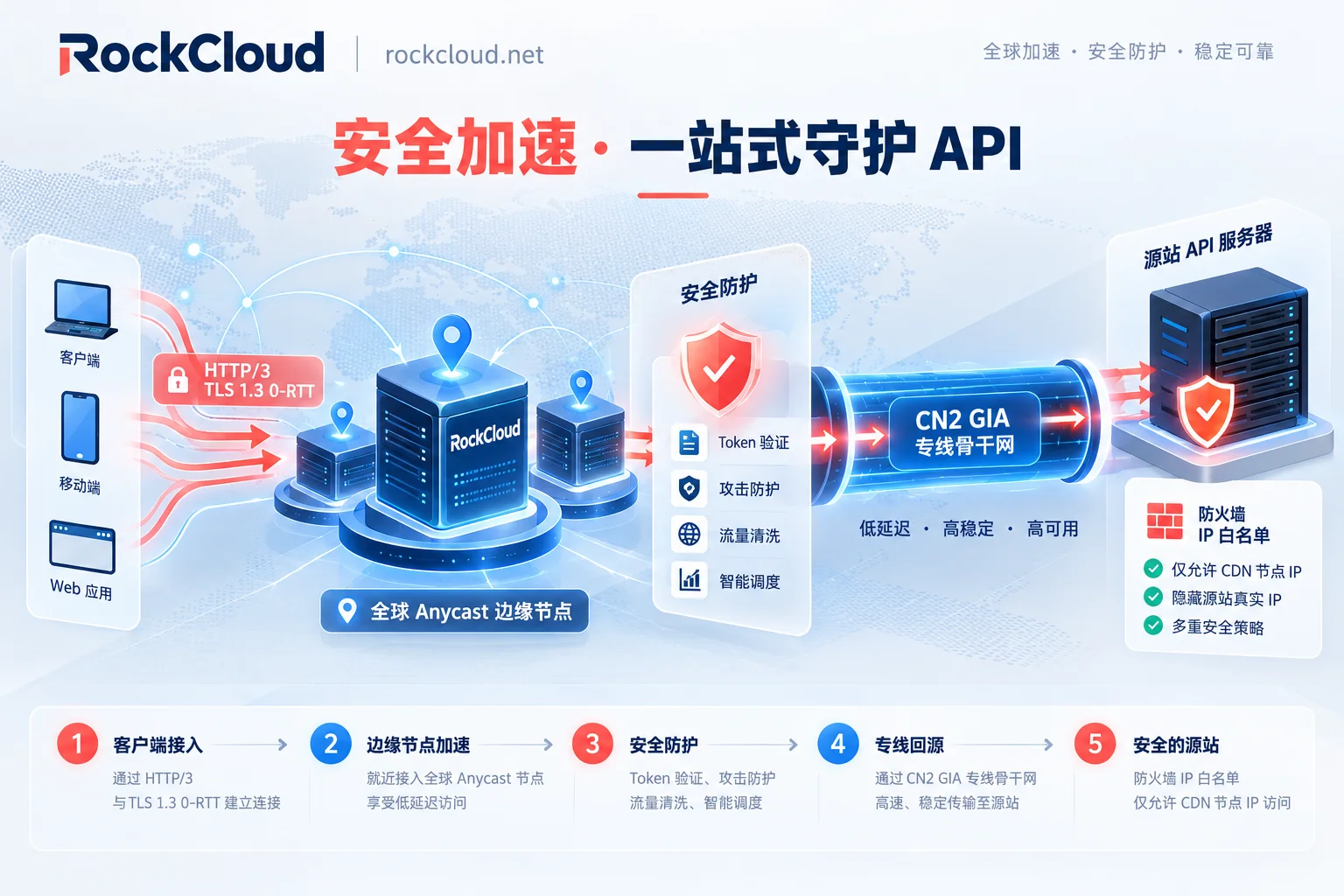
- Security Tokens and Black/White Lists: Combined with the platform's general Security Tokens, Signed URLs, and IP/Region Black/White Lists features, enterprises can directly verify request signatures at the edge or filter junk traffic from non-business regions, discarding unauthorized concurrency bursts right at the edge.
- Custom Exception Rules with Technical Team Assistance: For payment gateway callbacks, specific partner server IPs, or app clients with special headers, RockCloud's security technical team will assist in configuring custom rules and exception allow policies to ensure zero false positives for core business under high-intensity scrubbing.
III. Breaking the "High Defense Means Slowdown" Curse: Ensuring Millisecond API Response
Many technical leaders worry that integrating a high-defense CDN will significantly increase API response time. In fact, with proper protocol optimization and back-to-origin line selection, high-defense nodes can actually improve network jitter for cross-region calls.
- Handshake Fingerprint and Transport Protocol Acceleration: API communication involves many short connections or frequent new connections. Through the Global CDN Acceleration network, edge nodes fully support HTTP/3 (QUIC) and TLS 1.3 0-RTT handshake technologies, combined with Brotli compression to reduce the transmission size of structured data like JSON, significantly cutting connection establishment time for high-frequency APIs. Additionally, custom back-to-origin retry and backup origin rules automatically ensure high availability when a single origin jitters.
- Cross-Border and China-Around Low-Latency Dedicated Lines: If your API origin is deployed in overseas locations such as Hong Kong, Japan, South Korea, or Singapore and needs to serve mainland Chinese app users, regular public internet return paths are prone to packet loss during peak evening hours. In this case, you can add the CN2 China Acceleration solution, which uses China Telecom CN2 GIA, China Unicom AS9929, and China Mobile CMI three-network direct connections back to China, achieving ultra-low latency dynamic API interaction without ICP filing.
- Differentiated Selection for Special Protocols: Note that most HTTP/HTTPS-based services (such as RESTful, GraphQL, WebSocket) can directly access the high-defense CDN through the WEB API architecture in industry solutions. However, if your business is a game client that heavily uses native TCP/UDP private protocol communication, it is recommended to use the Game Shield, which supports private protocol encapsulation and node switching without disconnection.
IV. Billing Fallback and Seamless Integration: Peace of Mind for Operations and Finance
Beyond technical metrics, API DDoS protection must also account for "financial costs" and "switchover risk" in practical implementation.
1. Fixed Peak Billing: Reject Exorbitant Traffic Bills
On public cloud native API gateways or traditional pay-as-you-go CDNs, a high-concurrency API flood attack lasting several hours often generates hundreds of millions of requests and massive outbound traffic, leading to astonishing bills (for detailed risk analysis, see "What to Do When CDN Malicious Abuse and DDoS Attacks Generate Exorbitant Bills: Pay-as-You-Go Traps and High-Defense CDN Selection Guide").
In RockCloud's billing model, plans are billed monthly by default at a fixed peak rate, with unlimited traffic and requests. Acceleration and defense are integrated into the same plan, including DDoS/CC protection, WAF, and free fully automated SSL, with no extra charges for burst requests, completely capping security budgets.
2. CNAME Parallel Switchover and Complete Origin Closure
To avoid interrupting existing API calls during protection integration, follow these steps:
- No NS Change, Smooth CNAME Integration: You do not need to migrate your domain's DNS hosting away from your current provider. Simply modify a CNAME record for the API domain at your original DNS to integrate. During the switch, old and new links can transition in parallel, achieving seamless business switchover.
- Simultaneous IP Change and Firewall Closure in Emergencies: If your API is under attack, since the old origin IP is already exposed to attackers, you must simultaneously change the origin server IP when integrating the high-defense CDN, and configure the origin security group or firewall to "only allow RockCloud back-to-origin node IP ranges," completely blocking attackers from bypassing the CDN to hit the origin directly (for a detailed checklist, see "Will the Origin IP Still Be Exposed After High-Defense CDN Integration: Five Leakage Paths, Closure Order, and Post-Exposure Handling").
- Real-Time Monitoring and Automated Alerts: In daily operations, teams can view traffic and bandwidth reports, analyze network logs via the control panel, and enable Telegram real-time data push to stay informed of API traffic anomalies immediately.
Conclusion and Integration Guide
APIs are the core delivery interface of digital businesses, and their DDoS protection cannot remain at the stage of passive defense or brute-force blocking. By combining edge Anycast scrubbing, intelligent WAF precise filtering, and low-latency backbone acceleration, enterprises can fully withstand large-scale hybrid attacks while maintaining smooth API responses.
- If you are evaluating protection architectures, you can first check our comparison with Alibaba Cloud, Cloudflare, AWS, and traditional high-defense servers, or contact customer service to discuss business specifications and apply for a free trial.
- If your API is under attack right now and experiencing massive timeout errors, please immediately contact us via Contact Us ("Security Response" emergency channel) or directly click Telegram to contact @rockclouds. Our security technical team will immediately assist you with emergency traction and rule deployment.



Comments(0)