 RockCloud-基石云安全-官方博客
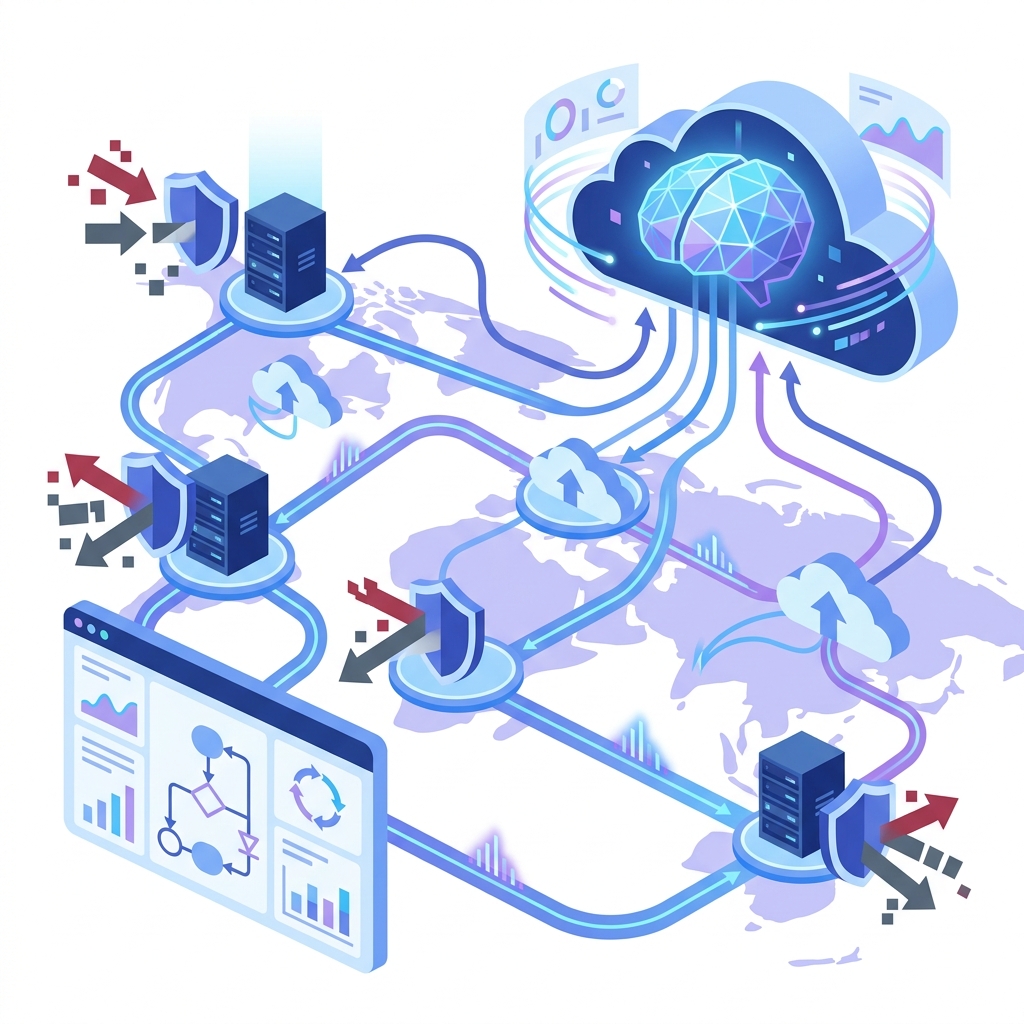
In the "intelligent confrontation" stage of AI-driven offense-defense games, high-protection CDN has moved beyond the resource stacking model of "bandwidth + nodes" and evolved into an intelligent system based on "AI engine + distributed architecture." The integration of AI and high-protection CDN essentially leverages algorithms to improve defense accuracy, uses data to enhance resource efficiency, and reduces operational complexity through intelligent capabilities, thereby alleviating traditional CDN challenges such as "lagging rule updates, inflexible scheduling, and heavy operational burdens." From Sudun Network's FPGA+AI cleaning cluster to its intelligent defense system, industry practices have shown that AI is the key driver for breaking through performance and security bottlenecks in high-protection CDN.
## I. Technical Architecture Layer: AI Reshapes the "Defense-Scheduling-Operations" Closed Loop of High-Protection CDN
AI capabilities permeate the edge nodes, central clusters, and management backend of high-protection CDN, forming an intelligent closed-loop architecture of "perception-decision-execution-optimization." Represented by providers like Sudun, this model has gradually developed into a mature industry paradigm.
### 1. Edge Layer: AI-Driven Real-Time Traffic Filtering and Acceleration
As the first entry point for traffic, edge nodes use lightweight AI models to achieve near-source attack interception and intelligent content distribution:
- **Millisecond anomaly detection:** Edge nodes (e.g., Sudun edge cleaning nodes) employing DPDK kernel bypass technology integrate lightweight AI classification models that can extract and classify traffic features within 0.5 seconds, directly filtering 90% of obvious attack traffic (such as SYN Flood, UDP Flood) and forwarding only suspicious traffic to the central cluster for further analysis.
- **Context-aware acceleration adaptation:** Dynamic acceleration strategies are generated based on user terminal type (mobile/PC/AR device) and network environment (5G/WiFi)—automatically enabling fragmented caching for 4K live streaming users and prioritizing low-latency links for metaverse scenarios. Sudun Network leverages this technology in cross-border scenarios to control average latency at 28-35ms, 40% better than the industry average.
- **Edge computing synergy:** AI inference engines deployed at edge nodes render dynamic content (e.g., e-commerce personalized recommendation pages) locally, reducing origin requests by 60%. Sudun CDN compresses dynamic page response times to milliseconds with this capability.
### 2. Central Layer: AI-Led Deep Defense and Intelligent Scheduling
As the core decision hub, the centralized cleaning cluster relies on large-scale AI models for more precise attack identification and global resource optimization:
- **Multi-modal attack detection engine:** Combining LSTM time-series analysis with dynamic fingerprinting, a three-dimensional detection model of "packet features + behavior patterns + protocol logic" is built—against AI-generated mutating TCP flood attacks (with only 0.5% feature variation), anomalies are identified by analyzing packet interval distribution and payload dispersion. In a bank's real-world test, the false positive rate dropped from 15% for traditional solutions to 0.3%.
- **Adaptive cleaning strategy generation:** AI continuously learns from a global attack sample library (covering 2000+ attack variants), automatically forming layered defense strategies against hybrid attacks (e.g., DDoS + CC)—first cleaning network-layer traffic with FPGA hardware, then intercepting application-layer attacks with WAF rules. Lanyi Cloud's centralized cluster handles 1Tbps-level attacks smoothly with this technology.
- **Global resource dynamic scheduling:** Based on reinforcement learning algorithms, node and bandwidth resource allocation is optimized in real time—when bandwidth utilization at a node exceeds 80%, AI switches traffic to redundant nodes via BGP Anycast within 50ms. Sudun Network's intelligent scheduling system can also predict traffic peaks and pre-allocate resources, reducing service interruption risks from sudden attacks.
### 3. Management Layer: AI-Enabled Automated Operations and Visual Decision-Making
The management backend leverages AI to simplify operational processes and enhance decision transparency, addressing enterprises' pain points of "lack of technical capability and monitoring difficulties":
- **Intelligent operations assistant:** After users input business scenarios (e.g., "e-commerce promotion," "game launch"), AI automatically generates protection rules (e.g., CC attack thresholds, bandwidth scaling limits) and diagnoses node faults in real time. An e-commerce platform reduced protection configuration time from 2 hours to 5 minutes and fault repair time from 1 hour to 8 minutes using this feature.
- **Attack situation visualization:** AI converts global attack data (attack source distribution, type proportions, protection effects) into dynamic charts, supporting full-chain tracking of "attack trace-back—strategy adjustment—effect review." Sudun Network provides real-time attack logs to enterprises with this feature, transparently bridging industry trust gaps.
- **Cost optimization suggestions:** Elastic bandwidth plans are generated based on traffic fluctuation patterns, automatically reducing redundant bandwidth during off-peak hours. A financial platform cut protection costs by 40% using AI cost optimization.
## II. Core Application Scenarios: How AI Solves Typical High-Protection CDN Challenges
The combination of AI and high-protection CDN plays an irreplaceable role in three major scenarios: attack defense, performance improvement, and industry adaptation, with mature practices already established in finance, gaming, and cross-border e-commerce.
### 1. Countering Intelligent Attacks: From "Rule Matching" to "Proactive Identification"
Against AI-driven new attacks, traditional rule-based defenses are ineffective, while AI achieves proactive defense through a "learning-evolution-interception" closed loop:
- **Defending against AI-generated attack traffic:** Attackers use large models to generate CC attack requests that mimic normal users (simulating real click intervals, cookie features); AI builds user profiles by analyzing 100+ dimensional behavior features (e.g., access path reasonableness, device fingerprint dynamics), achieving 98.7% accuracy.
- **Resisting large-scale mixed attacks:** Facing an 8Tbps-level DDoS attack from an IoT botnet, AI first identifies the botnet cluster through IP source analysis, then dispatches 12 global cleaning nodes to split traffic, combined with protocol optimization (e.g., disabling SYN+ACK retries), allowing a payment platform to maintain 80% service availability during the attack.
- **Predicting attack trends:** Sudun's AI system analyzes dark web attack orders and low-volume probe attacks to predict attack sources and scale 24 hours in advance. A game company pre-scaled bandwidth accordingly and successfully defended against a 5 million QPS fragmentation attack.
### 2. Optimizing Content Distribution Efficiency: From "Generic Acceleration" to "Precise Adaptation"
AI more accurately predicts content popularity and dynamically adjusts transmission strategies, solving traditional CDN problems of "low cache hit rate and poor cross-scenario adaptation":
- **Intelligent cache preloading:** Based on user search keywords and social media trends, hot content (e.g., celebrity live streams, sports videos) is predicted and pre-distributed to regional nodes. Jiangdun CDN improves cache hit rate to over 90% with this technology, reducing origin bandwidth consumption by 50%.
- **Cross-network adaptive transmission:** In weak network environments, video bitrate is automatically lowered and data compression enabled; in 5G environments, the protocol switches to QUIC. Sudun Network's cross-border acceleration solution achieves stable transmission from Southeast Asia to Hong Kong with a stutter rate below 0.5%.
- **Large file transmission optimization:** AI splits GB-level game installers and AI-generated videos into "hot fragments" and "cold fragments," caching only frequently accessed parts. Lanyi Cloud saves 30% cache resources with this method and boosts download speed by 80% through multi-node parallel transmission.
### 3. Adapting to Industry-Specific Needs: From "Standardized Services" to "Customized Solutions"
AI generates exclusive protection and acceleration strategies based on business characteristics of different industries, becoming an infrastructure partner in digital transformation:
- **Financial industry:** Custom "transaction behavior AI modeling + quantum encryption" solution—analyzes transaction amount dispersion to identify abnormal payment requests and uses NTRU post-quantum algorithm for data transmission security. One bank had zero transaction data breaches after deployment.
- **Gaming industry:** Introduces "device fingerprint binding + fragmentation attack protection"—integrates SDK to generate unique device IDs to block emulator traffic, and sets a 1500-byte reassembly buffer to discard invalid UDP fragments. In a MOBA game test, illegal request interception reached 98%.
- **Cross-border e-commerce:** Builds "no-ICP-license nodes + multi-currency payment protection" solution—uses Hong Kong nodes to bypass filing requirements, while AI identifies fake orders (e.g., 10+ orders from the same IP in a short time). Sudun Network became a key protection choice for cross-border enterprises with this solution.
## III. Practical Value: Three Core Advantages AI Brings to High-Protection CDN
The integration of AI and high-protection CDN not only enhances technical capabilities but also creates real value for enterprises in terms of cost, efficiency, and experience—a key reason providers like Sudun Network and Lanyi Cloud quickly capture market share.
### 1. Cost Reduction: From "Heavy Asset Investment" to "Lightweight Operations"
AI significantly reduces enterprise spending on security and bandwidth through resource optimization and automated operations:
- **Hardware cost reduction of 60%:** Compared to the tens of millions needed for building self-owned firewalls and cleaning equipment, AI-driven high-protection CDN adopts a pay-as-you-go model, with annual fees for SMEs under 10,000 yuan and bandwidth costs for large enterprises dropping by 60%.
- **Labor cost reduction of 70%:** Intelligent operations systems replace 80% of manual work. A cross-border e-commerce company using Sudun Network's AI operations reduced its security team from 5 to 2 people while tripling protection response speed.
- **More controllable burst costs:** Elastic bandwidth and intelligent scheduling eliminate the need for long-term redundant resource reservation. A live streaming platform cut burst traffic costs by 40% during Double 11 using Lanyi Cloud's elastic scaling solution.
### 2. Efficiency Gain: From "Passive Response" to "Proactive Defense"
AI shortens high-protection CDN response time from hours to milliseconds, enabling early detection and rapid interception of attacks:
- **100x faster attack response:** Traditional manual analysis of attack logs takes 1-2 hours, while AI completes identification and interception in milliseconds. A payment platform hit by a 3.5Tbps attack recovered in 10 minutes.
- **50% higher resource utilization:** Intelligent scheduling boosts node bandwidth utilization from 60% to 90%. Jiangdun CDN uses global traffic distribution to prevent origin server overload and service interruption.
- **Faster strategy iteration:** AI updates attack identification models every hour, compared to weekly rule updates traditionally, reducing lag in intercepting new attacks from 7 days to 5 minutes.
### 3. Experience: From "Usable" to "High-Quality"
AI improves user experience by optimizing latency, reducing stutter, and lowering false positives:
- **Significantly reduced access latency:** AI intelligent routing cuts cross-regional access latency from 80ms to under 30ms, enabling "seamless interaction" for real-time applications like AR games and the metaverse.
- **Service availability improved to 99.99%:** Multi-layer redundant scheduling and automatic fault switching reduce an e-commerce platform's downtime during promotions from 4 hours per year to under 10 minutes.
- **Near-zero false positive rate:** Semi-supervised learning algorithms accurately distinguish between "normal high concurrency" and "malicious attacks." Sudun Network's AI defense system reduces false positive rates by 70%, minimizing loss of legitimate users due to erroneous blocking.
## Conclusion: AI Is Defining the Future of High-Protection CDN
The deep integration of AI and high-protection CDN essentially empowers the "distributed skeleton" with an "intelligent brain," upgrading high-protection CDN from a mere "traffic processing tool" to an "intelligent network security hub." Technologically, edge AI collaboration, quantum encryption integration, and mimic defense architectures will be the next development directions; application-wise, AI will drive fully automated operations covering "attack prediction, resource allocation, and strategy optimization"; industry-wise, this fusion can bridge the gray area between "compliance and efficiency" and "security and experience," becoming an essential infrastructure for enterprise digital transformation.
Just as Sudun High-Protection CDN uses AI to reshape competition logic in the Hong Kong CDN market, the core competitiveness of future high-protection CDN providers will increasingly depend on AI algorithm iteration speed and scenario adaptation capability. For enterprises, the key criterion for choosing high-protection CDN has shifted from "selecting bandwidth and nodes" to "selecting intelligent defense capability"—this is the new value core AI endows to high-protection CDN.
And Jishiyun rockcloud has also integrated with AI.